
Last modified: 2026-10-31 by rob raeside
Keywords: colombia | army |
Links: FOTW homepage |
search |
disclaimer and copyright |
write us |
mirrors
See also:
Army Divisions - continued from this page
 image by Eugene Ipavec,
This flag was spotted on February 24, 2008 during a military
fair. It is the flag of the Grupo de Caballería Mecanizada
No. 4 "Juan del Corral" (Mechanized Cavalry Group No. 4
'Juan del Corral'). It is part of the Cuarta Brigada (Fourth
Brigade), Séptima División (Seventh Division).
The flag is on yellow background symbolizing Mechanized Cavalry
Units and it has the Cavalry Coat of Arms, seen on the
website of the ESCAB (Escuela
de Caballería, Cavalry School).
It is likely that the colors of the Arms (i.e. Cavalry, Infantry,
etc.) of the Army have been taken based upon US Army standards.
E.R., 17 April 2008
 image by Eugene Ipavec, 11 August 2009
War Flag - Batallón de Infantería No. 1
"Colombia"
 image by Eugene Ipavec, 11 August 2009
War Flag - Batallón de Infantería No. 2
"Colombia"
 image by Eugene Ipavec, 3 November 2005
Standard - "Batallón de
Infantería Colombia" No. 3
.jpg) image contributed by E.R., 15 June 2005
Coat of Arms - "Batallón de
Infantería Colombia" No. 3
The MFO is an indpendent "task force", created after
the Camp David Accords (1978). It is an independent international
organization (non-UN peacekeeping force) and it is made up of
different countries. The Multinational Force & Observers is
responsible for supervising implementation of the security
provisions of the Treaty of Peace between Egypt and Israel.
The "Batallón de Infantería Colombia" No. 3 (Infantry
Battalion No. 3 "Colombia"), abbreviated BICOL, is
attached to the MFO. Official website at bicol3.galeon.com.
Here is a photo of the
pennant of Infantry Battalion No. 3 "Colombia".
E.R., 15 June and 3 November 2005
The flag of the Batallón de Infantería No. 2
"Colombia" is seen here in this
picture
taken on July 20, 2004. Notice that on the bottom fringe it reads
on yellow capital letters: BATALLON INF. COLOMBIA Nº2.
E.R., 10 August 2009
The BICOL , more commonly known as Batallón Colombia
(Colombia Battalion) has had several denominations regarding their
deployments as follows:
Batallón Colombia No. 1 was Deployed during the
Korean War (1950-1953). After the North Korean invasion of South
Korea on June 25th, 1950, the UN Secretary General Trygve Lie
appealed to the member nations for support against this
aggression. Newly elected (not yet in office) Presidential
Candidate Laurean Gómez had already showed his support for the
South Koreans in a public speech on June 30 of this same year.
The Minister of War of that time, Roberto Urdaneta, had offered
military aid by July 28, which became formal on November 14. On
December 26, 1950, by Decree No. 3927, the Batallón de
Infantería No. 1 "Colombia" was established with 1,060
soldiers including the Frigate A.R.C. Almirante Padilla (FG 11),
ex USS Groton (PF-29) of 180 men, which had been sold to Colombia
on March 26, 1947. The Frigate served under U.S. Task Force 95.
Later on, two other Colombian Frigates replaced the A.R.C.
"Almirante Padilla". First was the A.R.C.
"Capitán Tono", ex USS Bisbee (PF-46) acquired by
Colombia through the Mutual Defense Assistance Act commonly known
as the Battle Act. Then the A.R.C. "Almirante
Brión" (FG 14), ex USS Burlington (PF-51), sold to Colombia
on June 26, 1953. The Army and Naval Units served until 1955.
The Batallón Colombia which served under the U.S. Army 7th
Infantry Division, had several relevos (relays or replacements)
so they were called Contingente No. 1, No. 2, etc. (Contingents
No. 1, No. 2, etc.). A total of 4.314 men participated in this
first Batallón Colombia. Many awards and decorations were
awarded to the Battalion as well as to many of its individuals.
Sources:
www.caballerosandantes.net
, www.armada.mil.co
and ascove.org.co.
The Battalion flag is seen here in the following pictures taken
on July 20, 2009:
here,
here
and
here.
The inscription on the lower fringe of the yellow circle
surroundin the Colombian Coat of Arms reads: BATALLON COLOMBIA
N°1.
Batallón Colombia No. 2 - The first United
Nations Emergency Force (UNEF) was established by United Nations
General Assembly to secure an end to the 1956 Suez Crisis with
resolution 1001 (ES-I) on November 7, 1956. The force was
developed in large measure as a result of efforts by UN
Secretary-General Dag Hammarskjöld and a proposal from Canadian
minister of external affairs Lester Pearson. The General Assembly
had approved a plan submitted by the Secretary-General which
envisaged the deployment of UNEF on both sides of the armistice
line. However, the government of Israel refused to permit UNEF to
deploy on their side of the line. After multilateral negotiations
with Egypt, eleven countries offered to contribute to a force on
the Egyptian side of the armistice line: Brazil, Canada,
Colombia, Denmark, Finland, India, Indonesia, Norway, Poland,
Sweden, and Yugoslavia. Support was also provided by United
States, Italy, and Switzerland. The first forces arrived in Cairo
on November 15, and UNEF was at its full force of 6,000 by
February 1957. The force was fully deployed in designated areas
around the canal, in the Sinai and Gaza when Israel withdrew its
last forces from Rafah on March 8, 1957.
The Batallón Colombia No. 2 was part of this mission. UNEF ended
its mission in May 1967
Sources:
Wikipedia.
Batallón Colombia No. 3 In accordance with the Camp David
Accords, and after a petition from the MFO
Commander Lemon R. Hunt, Colombia issued Disposition
No. 00013 of 16 of October, 1981. Then by Decree No. 692 of March
5, 1982 the Batallón Colombia No. 3 is established and it was
made up of 40% Infantry , 20% Cavalry, 20% Artillery and 20%
Engineers. It was sent to the Sinai Peninsula on October 8, 1982
as part of the MFO
Source: www.ejercito.mil.co.
E.R., 11 August 2009
 image by Eugene Ipavec, 12 January 2010
Batallón Colombia War Flag - The flag is the Colombian
Tricolor, with the Coat of Arms, and on the top fring it reads
REPUBLICA DE COLOMBIA in bold capital golden letters, and on the
bottom it reads BATALLON COLOMBIA.
You can see an actual picture
of the flag at
Unofficial
Colombian Military Forces website.
E.R., 12 January 2010
Unusual in that the ring is a very dark red; normally on
these flags it is plain red.
Eugene Ipavec, 12 January 2010
There was an article published four days ago on the
Army's
official website showing a ceremony for new replacements into
this Battalion. A
picture
on the article shows a variant of the BICOL Standard Pennant we
show above. The difference in this variant is the number 3, which
corresponds to the actual Battalion stationed there, as displayed
on the War Flag.
E.R., 25 January 2010
 image located by Esteban Rivera, 19 July 2011
I found the Pennant for 'Compañía
D' (D Company) of the Batallón Colombia while stationed during
the Korean War (1950-1953)
Image of pennant.
Source:
http://foro.unffmm.com/viewtopic.php?f=40&t=323
Esteban Rivera, 19 July 2011
It looks pretty unmistakably like a signboard nailed to two wooden posts.
Eugene Ipavec, 20 July 2011
See: Batallón Colombia- Rank Flags
See also: Sinai Multinational Force & Observers Flag
 image by Eugene Ipavec, 20 November 2005
War Flag
 image by Eugene Ipavec, 14 September 2006
Standard
 image by Eugene Ipavec, 20 November 2005
Pennant
.gif) image by Eugene Ipavec, 14 September 2006
coat of arms
The AFEAU (Agrupación de Fuerzas Especiales Antiterroristas
Urbanas, Urban Special Antiterrorist Forces Group) are an elite
force depending directly from the Comando General de las Fuerzas
Militares (General Command of Military
Forces).
The Additional official flag should be the official flag of
Colombia with the same ratio with Coat of Arms, but the
inscription on the upper red fringe of the Coat of Arms reads
"REPUBLICA DE COLOMBIA" and the bottom inscription
should read AFEAU. The image is based on photo from Colombia's
Independence Day, July 20th, 2002. taken from the Ministry of
National Defense official website.
The Pennant is based on photo taken from TV channel Canal A. The
photo is from Colombia's Independence Day, July 20th, 2003.
Homepages of AFEAU at
www.ejercito.mil.co
and
www.cgfm.mil.co.
E.R., 20 November 2005
The difference between the Brigada de Fuerzas Especiales (Special Forces Brigade) and the AFEAU (Urban
Special Antiterrorist Forces Group), is that the Brigade is made
up of Battalions that operate temporarily attached to any given
Army Battalion or Army Brigade, with national jurisdiction, while
the AFEAU units are platoon-sized elements that are permanently
based on the Headquarters of each Army Division, so they only
have operational jurisdiction over the area in which their
Division operates. Now, there are five AFEAU groups even though
there are seven Army Divisions in existence: the Colombian
government is getting the funds and its men trained in order to
create two more AFEAU groups.
Source: www.ejercito.mil.co.
E.R., 25 December 2005
Information on the AFEAU: Fuerzas Especiales Anti-Terroristas
Urbanas (AFEAU)  www.specialoperations.com
- Urban Counterterrorist Special Forces. The national hostage
rescue/counterterrorist unit is the Fuerzas Especiales
Anti-Terroristas Urbanas (AFEAU). It is made up of between 70 and
100 personnel from all branches of the Armed Forces as well as
the National Police and is under the overall command of the
Comandante de las Fuerzas Armadas (Commander of the Armed
Forces). The unit is divided into four 15-man sub-units, one each
from the Colombian Army, Navy, Marine Corps and National. Each
sub-unit is comprised of two officers and 13 enlisted ranks, all
of whom are volunteers. AFEAU is commanded by an Army major who
heads a headquarters section comprised of an executive officer,
first sergeant, communications operator. It was created as a
direct result of the failed assault on the Palace of Justice in
Bogota on November 5 and 6, 1985, which resulted in the deaths of
not only the M-19 terrorists, but
also some 80 soldiers, policemen and hostages as well. In
addition to the assault teams, the AFEAU has dedicated sniper
teams, a crisis management team, and a hostage negotiation
element.
Training is carried out primarily at a facility in Facatativa,
north of Bogota. Members are schooled in a wide variety of
disciplines, including close-quarters combat, short and longs
range marksmanship, hand-to-hand combat, and even air assault
operations. Specific hostage rescue skills are developed for the
major transportation scenarios including trains, busses, and a
wide variety of airplanes.
The ring of the coat of arms contains the inscription
"COMANDO FUERZAS ESPECIALES". The acronym spell AFEUR.
Concerning AFEAU v. AFEUR - AFEAU stands for Agrupación de
Fuerzas Antiterroristas Urbanas... and AFEUR stands for
Agrupación de Fuerzas Antiterroristas Urbanas y Rurales.
Both are exactly the same thing: that is, there is no
difference because those are two ways to refer to them (The
emblem and the flag say AFEUR but for example, the pennant reads
AFEAU, and the official website on the internet also says AFEAU).
After several months of research on this subject, I have come to
the conclusion that they are the same thing: however their
uniforms are different when it comes to rural operaions
(bascially army jungle camouflage pattern) and urban operations
(a kind of snow environment camouflage, in different shades of
gray). The gear is the same for all groups and there are AFEAU
Police units and AFEAU military units.
E.R., 14 & 18 September 2006
There's an article on the organization of the AFEAU at
www.cgfm.mil.co.
It says that the AFEAU is composed of five Destacamentos
(Detachments) as follows:
- Alpha (Army)
- Bravo (Navy)
- Charly (Air Force)
- Delta (Police)
- Omega (Expert sharpshooters).
E.R., 18 August 2009
 image by Eugene Ipavec, 11 August 2009
Standard
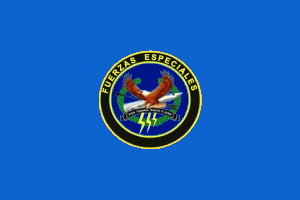 image by Daniel Rentería, 25 June 2025
Blue variant with thunderbolts
image taken by Esteban Rivera, 14 December 2024
 image by Eugene Ipavec, 25 December 2005
Square Pennant
 image by Eugene Ipavec, 25 December 2005
Triangular Pennant
All Colombian Military Units have an official flag and also an
official pennant (usually having the initials of the unit). This
is the Pennant of this military unit called Brigada de Fuerzas
Especiales, or Special Forces Brigade. It's abbreviation is
BRFER.
It is directly below the General Command
of Military Forces in the structure on the military
organization. The difference between the Brigada de Fuerzas
Especiales (Special Forces Brigade) and the AFEAU
(Urban Special Antiterrorist Forces Group), is that the Brigade
is made up of Battallions that operate temporarily attached to
any given Army Battalion or Army Brigade, with national
jurisdiction, while the AFEAU units are platoon-sized elements
that are permanently based on the Headquarters of each Army
Division, so they only have operational jurisdiction over the
area in which their Division operates. Now, there are five AFEAU
groups even though there are seven Army Divisions in existence:
the Colombian government is getting the funds and its men trained
in order to create two more AFEAU groups.
Source: www.ejercito.mil.co.
E.R., 25 December 2005
The BRFER flag is seen displayed
here.
It is the red color Army flag with the Coat of Arms on the middle
on a dark blue background. Below it reads COMANDO. This Coat of
Arms is based on the badge of the graduates of the
Special Forces School. The flag on
the picture actually has the old logo of the Contraguerrilla
Commando (Counter guerrilla commando) insignia which is featured
on this paramilitary flag. The
counter guerrilla insignia representing an eagle catching a snake
was taken without permission by the paramilitary group, in fact
many paramilitary members wear green T-shirts underneath their
camouflage uniforms, and those T-shirts have the eagle as logo.
The new logo is here.
E.R., 10 August 2009
The Special Forces were established through Resolution 011 of
1970 issued by the General Command of the Army.
Sources: [1], [2],
[3].
On March 24, 2011 I found some information on the Batallón Guardia
Presidencial (Presidential Guard Battalion) flag.
The current Battalion is officially called Batallón de Infantería No. 37
'Guardia Presidencial' (Infantry Battalion No. 37 "Presidential Guard"), and it
was established on December 7, 1927 by President Miguel Abadí Méndez. Later on,
by Decree No. 367 of 1928 is named "Batallón Guardia Presidencial". It has its
origins in the Guardia de Honor (Honor Guard) established by General Simón
Bolívar in 1814.
The Battalion is under the command of the Army's 13th Brigade,
5th Division and has the following Companies:
- Compañía de Infantería (Infantry Company), known as Córdova Company
- Compañía de Caballería (Cavalry Company), known as Rondón's Company
- Compañía de Artillería (Artillery Company), known as Ricaurte's Company
- Compañía de Ingenieros (Engineers Company), known as Caldas Company
- Pelotón de Soldados de la Casa Militar (MIlitary House Platoon), known as
Fergusson's Company.
Source:
http://es.wikipedia.org/wiki/Casa_de_Nari%C3%B1o#Defensa
The Battalion's flag is a horizontal flag, green (25%) /white (50%) /green
(25%), with the coat of arms in the middle. The coat of arms has a roundel in the middle with the
inscription "BATALLÓN GUARDIA", on top in bold capital black letters, and
"PRESIDENCIAL" on the bottom in bold capital black letters.
Images:
Battalions' flag, first version, with the
coat of arms having a red background.
Source:
http://www.facebook.com/group.php?gid=5187328501#!/photo.php?fbid=438403995100&set=o.5187328501&theater
Battalions' flag, second version, with
the coat of arms having a white background
Sources:
http://www.facebook.com/group.php?gid=5187328501#!/photo.php?fbid=10150096361141894&set=o.5187328501&theater,
Image of coat of arms:
http://www.facebook.com/group.php?gid=5187328501#!/photo.php?fbid=10150096361136894&set=o.5187328501&theater
Source:
http://www.facebook.com/group.php?gid=5187328501#!/photo.php?fbid=450197609137&set=o.5187328501&theater
(Another version of the coat of arms is found
here)
Additional sources:
-
http://www.terra.com.co/actualidad/galerias/gal54400.htm (Picture
gallery of the 80th anniversary o the Battalion)
-
http://www.youtube.com/watch?v=1Russ8j8AjY (video showing the
Battalion's flag (from 0:14 until 0:18 and 1:37 until 1:44
-
http://wsp.presidencia.gov.co/CasaNarino/Paginas/CasadeNarino3.aspx
(Picture)
-
http://wsp.presidencia.gov.co/CasaNarino/Paginas/CasadeNarino6.aspx
(Picture)
-
http://wsp.presidencia.gov.co/CasaNarino/Paginas/CasadeNarino7.aspx
(Picture)
Semi official page of the Batallón No. 37 Guardia Presidencial:
http://www.ejercito.mil.co/?idcategoria=277533
Esteban Rivera, 22 May 2011


.jpg)
